Happy World Malaria Day! God is able to do abundantly more than we can ask or even imagine... and we can know the joy of being part of God's work in the world!
Showing posts with label abundant life. Show all posts
Showing posts with label abundant life. Show all posts
Monday, April 25, 2016

Monday, April 6, 2015
#BringChange this World Malaria Day!
Happy Easter! May you experience the hope and joy of Resurrection this day and each day!
As we travel through the Easter season, you have the opportunity to continue bringing new life to those at risk for malaria. April 25th is World Malaria Day, and Imagine No Malaria has new resources available to equip you to take part in a social media campaign, to plan an event for your community, or to (re-)engage your congregation in new ways.
Head over to http://imaginenomalaria.org/page/bring-change to find out more, and make a world of difference this World Malaria Day!

As we travel through the Easter season, you have the opportunity to continue bringing new life to those at risk for malaria. April 25th is World Malaria Day, and Imagine No Malaria has new resources available to equip you to take part in a social media campaign, to plan an event for your community, or to (re-)engage your congregation in new ways.
Head over to http://imaginenomalaria.org/page/bring-change to find out more, and make a world of difference this World Malaria Day!
Friday, February 14, 2014
Resources for Lent

Seems like church leaders can never fully enjoy the present day or season because they always have to be thinking a month or two ahead to plan for the next. Ash Wednesday is March 5, less than 3 weeks away.
If your church is considering taking on Imagine No Malaria as a mission focus for Lent this year, we have some new resources to help you out! View and download any or all of the following:
- Guide for Lent (developed by INM-Iowa Conference)
- Giving from Abundance Calendar
- Bulletin Inserts
- Call to Action Poster
- Church-wide letter
- Lent slider image
- World Malaria Day Resources
Thursday, January 30, 2014
Breaking down the myths of global health, poverty, and progress
The Bill & Melinda Gates Foundation recently released their annual letter, and this year they identify and take apart three pervasive myths that block progress for the poor. Please consider reading the whole letter, as it is thoughtful, informative, and compelling. But for those with limited time, here are a few of the highlights.
Do these sound familiar? Are they part of your understanding of the world? The Gates Foundation takes on these beliefs not only because they are based on a pessimistic outlook that tends to inhibit action for positive change in the world, but also because the beliefs themselves are simply, factually, false.
Of course, there are still countries - and still significant portions of the population in some middle-income countries - where average per capita income is still just US$1-2/day. But there are fewer of these countries now than before, and all economic measures suggest that this global trend toward greater economic development, and the improvements in health, education, and infrastructure that tend to accompany it, will continue in the coming decades. This trend can be attributed in large part to the success of foreign aid.
If you like visual aids to help improve your understanding, check out these two short videos that address some of the nuances of Myths #2 and #3:
Bill Nye, the Science Guy, on the leading causes of death among young children, and how foreign aid - a tiny percentage of the US federal budget - makes a huge difference:
And Melinda Gates explains why improving health and saving people's lives is good for the planet - it actually reduces overpopulation in the long run:
In the interest of full disclosure: a grant from the Gates Foundation covers the administrative costs of Imagine No Malaria, including Field Coordinator compensation, but I'm sharing the letter here because it's interesting and relevant, not out of obligation!
The Three Myths
- Poor countries are doomed to stay poor
- Foreign aid is a big waste
- Saving lives leads to overpopulation
Do these sound familiar? Are they part of your understanding of the world? The Gates Foundation takes on these beliefs not only because they are based on a pessimistic outlook that tends to inhibit action for positive change in the world, but also because the beliefs themselves are simply, factually, false.
The Data
The letter goes into detail about how historical data demonstrates that many countries that were very poor just 50 years ago have since moved into a level of economic productivity that qualifies as middle-income on the global scale.Of course, there are still countries - and still significant portions of the population in some middle-income countries - where average per capita income is still just US$1-2/day. But there are fewer of these countries now than before, and all economic measures suggest that this global trend toward greater economic development, and the improvements in health, education, and infrastructure that tend to accompany it, will continue in the coming decades. This trend can be attributed in large part to the success of foreign aid.
Video Snapshots
If you like visual aids to help improve your understanding, check out these two short videos that address some of the nuances of Myths #2 and #3:
Bill Nye, the Science Guy, on the leading causes of death among young children, and how foreign aid - a tiny percentage of the US federal budget - makes a huge difference:
And Melinda Gates explains why improving health and saving people's lives is good for the planet - it actually reduces overpopulation in the long run:
Invest in Health, Change the World
Health care is not the only area of development important in improving the lives of the global poor, but it is a major piece of the puzzle. The 2014 Gates Annual Letter helps provide some concrete facts and figures to address concerns that often come up when we talk about Imagine No Malaria's work to prevent needless death and suffering from malaria and transform lives and communities across Africa. Please help us to spread the word and #StoptheMyth so we can make an even greater impact!In the interest of full disclosure: a grant from the Gates Foundation covers the administrative costs of Imagine No Malaria, including Field Coordinator compensation, but I'm sharing the letter here because it's interesting and relevant, not out of obligation!
Wednesday, January 1, 2014
New Year's Resolutions, or How to Save Lives in 2014

If you're looking for ideas on how to help proclaim God's love in the coming year, or want to share with family and friends what it means to be a United Methodist committed to putting faith into action, here are 10 ways to support Imagine No Malaria in 2014 - let me know in the comments if you take on one or more of these, or if you have other suggestions!
How to Save Lives in 2014
1. Schedule a monthly donation to Imagine No Malaria (make sure to check the box to indicate what church you're affiliated with). Remember:
- $10 Buys a life-saving insecticide-treated bed net
- $20 Pays for the cost of food and treatment of anemia in a pregnant woman with malaria
- $50 Provides malaria medication to treat ten adults
- $100 Covers the cost of an anti-malaria campaign in a local school
- $200 Trains Traditional Birth Attendants in malaria prevention and treatment
- $500 Provides all the resources for a one-day community leader training for 35-40 people on malaria prevention
- $28/month over three years adds up to a pledge of $1,000 that will save 100 lives - that's a whole community!

3. Like Imagine No Malaria - Rocky Mountain Conference on Facebook and follow @RMCbuzz on Twitter. Share or retweet a post at least once a month.
4. Host a screening of A Killer in the Dark, the documentary about the United Methodist Church's work to fight malaria in Africa. Invite friends, neighbors, coworkers, or church members to watch with you and discuss afterwards.
5. Talk to your pastor, Sunday school teacher, small group leader, or other church members to find out what your congregation is doing to support INM, and offer to help.

7. Contact your Senators and Representative in Congress to let them know that you support continued federal funding for global health work, including the President's Malaria Initiative. Tell the staff person you speak with that you are United Methodist and you are doing your part through Imagine No Malaria, and you hope the US government will continue to do its part to end this unnecessary source of suffering in our world.
8. Talk to leaders in your school, civic groups, local government, hospitals/clinics, or other congregations in your community to find out if they would like to partner with your church in saving children's lives in Africa.
9. Help your church leaders plan and put on an event that invites the whole community to come together in support of Imagine No Malaria. Possibilities include a basketball tournament, benefit concert, fundraising dinner, silent auction, knit-a-thon, variety show, or any creative option that will give people a chance to have fun while learning about malaria and giving generously.

Thank you for whatever step you can take to help make abundant life more possible for our sisters and brothers in Africa. Together, we are bringing hope and healing to millions of people: a great testimony to the Good News of God's love made known in Jesus Christ!
Tuesday, November 5, 2013
Charge Conference Season
 As a pastor friend of mine posted on Facebook recently, for United Methodist clergy and church leaders, this isn't yet the "holiday season"; it's "report season"! In our connectional system, each church (or charge, usually used if a pastor serves more than one church) where a pastor is appointed holds an annual business meeting to report to each other, to the district, and and to the (regional) conference office some of the highlights and challenges of ministry in the past year.
This includes lots of statistical and other numeric reporting - budgets, attendance, membership, baptisms, deaths, and so on - but also offers an opportunity for the church to practice telling its story about how God has been at work in and through the congregation. Not just, do we have enough money and do we have more or fewer people than in January, but also, how have we experienced the power of the risen Christ in our ministries? How are we responding to God's grace in our lives? How are we growing in the call to love our neighbor through prayers, presence, gifts, service, and witness? How is the kin'dom of God breaking through in our midst? And where might the Spirit be leading us in the coming year?
This year, one of the reports churches in the Rocky Mountain Conference will be asked to give is for Imagine No Malaria. District Superintendents (or their designated presiding elders) will be asking each church/charge to respond to 3 simple questions as part of their "holy business":
- How many lives does your church plan to save? ($10 saves a life)
- What progress have you made toward that goal? and
- What plans do you have between now and April 25, 2014?
If your church has not yet set a formal goal, this is an excellent opportunity to have that conversation. (Download the Imagine No Malaria Report form here to be ready to respond at your church or charge conference.)
Churches will also have an opportunity to take up an offering for Imagine No Malaria during the charge conference. If individuals wish to make gifts or pledges, they have two options: they can give to/through the local church, or make checks and pledge forms out to the Rocky Mountain Conference (RMCUMC). We encourage churches to track pledges that will be paid off over time, but we are always happy to receive information about individual donors so we can acknowledge them at the conference level as well.
The Rocky Mountain Conference Steering Committee understands that many churches are facing financial challenges, and also that there are many worthy causes that United Methodists are asked to support. However, we believe strongly that Imagine No Malaria is a vital and urgent opportunity for all of us to put our faith into action as we join the global movement to end deaths from this preventable, treatable, and beatable disease. We can be part of making history as we empower the people of Africa to win a sustainable victory over malaria within our lifetimes, and to make a more abundant life possible for communities across the continent. I hope you'll join us!
Tuesday, August 13, 2013
We are making progress - and the need continues!

First, in July, the BBC and Public Radio International aired a story (Bed Nets for Malaria: Losing the Arms Race?) that raised serious questions about whether bed nets were making genuine and sustainable progress in reducing malaria infections, because mosquitoes in some areas were shown to be developing resistance to the primary insecticide with which the nets are treated.
Rev. Larry Hollon, General Secretary of United Methodist Communications, wrote a thoughtful response to the questions raised in the BBC article. Rev. Hollon contended that malaria experts had long anticipated the problems now being observed, and that this evidence demonstrates the importance of a more comprehensive, holistic approach to eradicating malaria. This is one of many reasons that Imagine No Malaria goes beyond just bed nets to include other methods of prevention, alongside diagnosis and treatment, education, and communication strategies.
Then last week, CNN.com reported on a breakthrough in U.S. efforts to develop a malaria vaccine. A study conducted by the National Institute of Allergy and Infectious Diseases on a vaccine developed by Maryland-based company Sanaria showed highly promising results, but the initial trials were quite small, involving just 57 volunteers, and more extensive field testing is required before the drug can be considered scientifically proven in order to be approved for distribution - a process that could take 5-10 years.

Ending deaths from malaria in Africa is no small undertaking. This disease has been a scourge of humanity for thousands of years, but we know that it can be done because it has been done in the United States and other developed countries. What is needed to accomplish the same goal in Africa is, quite simply, the will to dedicate resources to ease the suffering of the poor who cannot otherwise afford quality health care, in order to enable more families, more communities, more nations to live life to the fullest - something that Jesus cared quite a bit about.
You can donate to Imagine No Malaria here or here, or text MALARIA RMC to 27722 to give $10. Thanks for helping us save lives!
Tuesday, July 16, 2013
Equip & Empower
One of the things I love about The United Methodist Church and our approach to mission and service work is that we really strive to go beyond a simple 'charity' approach. What I mean by that is we don't simply drop off supplies or funds to people in need and go home. Nor do we come in with a strict, cookie-cutter plan for how relief or development work should happen. Rather, through the United Methodist Committee on Relief and other agencies, we seek to partner with the people with whom we are in ministry.
We take time to listen to their needs, concerns, hopes, and strengths, and to learn from those living the experience what will be most helpful. And we work with local leaders to develop a plan that not only alleviates immediate suffering, but also builds capacity for the long term. Our goal is to equip and empower people in need to first become part of the solution and ultimately to chart their own future.
That's exactly what Imagine No Malaria is doing with the 16 African countries where Health Boards have been established and trained in economic sustainability for health care institutions. After learning best practices in planning fee structures, grant writing, and similar topics, members of the Health Boards - many of whom are health care providers themselves - have the opportunity to write grant proposals to the General Board of Global Ministries (UMC) and to The Global Fund to Fight AIDS, Tuberculosis, and Malaria.
Since 40-60% of health care in Africa comes from faith-based organizations (depending on the country), this work of equipping and empowering local leaders to pursue infrastructure development is vital--not only to reduce deaths from malaria, but also to increase opportunities for abundant life along a variety of measures. These leaders can share their knowledge and skills with colleagues and neighbors, who can then pursue similar improvements in education, nutrition, overall child and maternal health, economic development, and other areas.
And on the flip side of the initiative, we are also working to equip and empower individuals and congregations across the United States to become advocates and leaders in the fight against malaria here. If you want to get involved - and invite your church or community to join you - in this extraordinary effort to save lives and offer hope and healing in Christ's name, contact me, Kerry Greenhill, Field Coordinator, today: 303-733-3736 x152, or kerry@rmcumc.com. I'm currently scheduling volunteer trainings for summer and fall, and will make sure you get the information you need about training opportunities in your area.
Here is a tentative schedule of trainings over the next three months (subject to change, but updated here when they do); each training will last approximately 2 hours:
Date Day Time Location
July 31 Wednesday 11am Webinar (online/anywhere)
Aug 6 Tuesday 6:30pm Highlands UMC, Denver CO
Aug 10 Saturday 10am First UMC, Pueblo, CO
Aug 29 Thursday 6:30pm Hope UMC, Greenwood Village, CO
Sep 12 Thursday 6pm Durango, CO
Sep 13 Friday 6:30pm Hotchkiss, CO
Sep 14 Saturday 2pm Meeker, CO (UMW District Mtg)
Sep 18 Wednesday 6:30pm First UMC, Greeley CO
Sep 28 Saturday 10am First UMC, Casper, WY
Sep 29 Sunday 4pm First UMC, Cheyenne, WY
I am still hoping to add one or two Colorado trainings the week of August 26, and a trip to Utah sometime this fall! Hope to see you sometime soon as we equip and empower one another to proclaim the good news of God's desire for abundant life for all people!
 |
| Young people in Nigeria help educate their community about malaria |
That's exactly what Imagine No Malaria is doing with the 16 African countries where Health Boards have been established and trained in economic sustainability for health care institutions. After learning best practices in planning fee structures, grant writing, and similar topics, members of the Health Boards - many of whom are health care providers themselves - have the opportunity to write grant proposals to the General Board of Global Ministries (UMC) and to The Global Fund to Fight AIDS, Tuberculosis, and Malaria.
Since 40-60% of health care in Africa comes from faith-based organizations (depending on the country), this work of equipping and empowering local leaders to pursue infrastructure development is vital--not only to reduce deaths from malaria, but also to increase opportunities for abundant life along a variety of measures. These leaders can share their knowledge and skills with colleagues and neighbors, who can then pursue similar improvements in education, nutrition, overall child and maternal health, economic development, and other areas.
 |
| Rev. Kerry Greenhill leading a workshop at First UMC, Limon, CO |
And on the flip side of the initiative, we are also working to equip and empower individuals and congregations across the United States to become advocates and leaders in the fight against malaria here. If you want to get involved - and invite your church or community to join you - in this extraordinary effort to save lives and offer hope and healing in Christ's name, contact me, Kerry Greenhill, Field Coordinator, today: 303-733-3736 x152, or kerry@rmcumc.com. I'm currently scheduling volunteer trainings for summer and fall, and will make sure you get the information you need about training opportunities in your area.
Here is a tentative schedule of trainings over the next three months (subject to change, but updated here when they do); each training will last approximately 2 hours:
Date Day Time Location
July 31 Wednesday 11am Webinar (online/anywhere)
Aug 6 Tuesday 6:30pm Highlands UMC, Denver CO
Aug 10 Saturday 10am First UMC, Pueblo, CO
Aug 29 Thursday 6:30pm Hope UMC, Greenwood Village, CO
Sep 12 Thursday 6pm Durango, CO
Sep 13 Friday 6:30pm Hotchkiss, CO
Sep 14 Saturday 2pm Meeker, CO (UMW District Mtg)
Sep 18 Wednesday 6:30pm First UMC, Greeley CO
Sep 28 Saturday 10am First UMC, Casper, WY
Sep 29 Sunday 4pm First UMC, Cheyenne, WY
I am still hoping to add one or two Colorado trainings the week of August 26, and a trip to Utah sometime this fall! Hope to see you sometime soon as we equip and empower one another to proclaim the good news of God's desire for abundant life for all people!
Friday, June 21, 2013
Abundant life, abundant generosity
 |
| Fantastic pre-conference volunteers |
First of all, I could not have finished preparing all of our packets of materials in time if it weren't for the help of four fantastic volunteers on Tuesday before conference. Thanks to Hamu, Darcy, Michael, and LeAnn for your great - and fast - work!
 |
| Becky Buxton, our scientific expert on malaria |
 |
| CCYM selling cute & colorful mosquitoes (the fashion accessory of the year, according to Bishop Elaine) |
 |
| Robin Ball, Steering Committee Co-Chair, with the banquet centerpieces |
 |
| Rev. Gary Henderson, Executive Director of the UMC's Global Health Initiative |
 |
| The all-conference Mission Banquet on Friday night |
That support and commitment was made concrete in the abundance of gifts and pledges collected in the banquet, which totaled $40,188.61! In addition, Imagine No Malaria will receive half of the Bridge of Love offering from Saturday morning, which means that our total raised for Imagine No Malaria during annual conference is nearly $50,000, or 5,000 lives saved in just three days!
 |
| Rev. Kerry Greenhill (Field Coordinator) with a human-size mosquito! |
outpouring of generosity from conference participants. Clergy and lay members to annual conference are asked to give to several offerings from Thursday to Sunday, usually from their own wallets and checkbooks (unless a church has been organized enough to plan ahead and send funds with their delegates).
I believe that this work, to prevent unnecessary deaths and suffering from malaria, particularly among children and pregnant women, is truly what God desires from the Body of Christ. All who have received the gift of abundant life have an opportunity to receive blessing in the act of offering a blessing to others through their generosity. Thank you to all who recognized this opportunity and are joining in this extraordinary effort with the people called United Methodist around the world!
Monday, June 10, 2013
Do Something to Keep Children Alive!
Annual Conference begins Thursday - are you ready?
This week the Rocky Mountain Annual Conference will include a brief presentation Thursday afternoon to introduce the Steering Committee for Imagine No Malaria, and on Friday evening we'll enjoy a Missions Banquet with updates from Rev. Gary Henderson, Executive Director of the Global Health Initiative, on the overall scope of this ministry at the global level. If you're at annual conference, you won't want to miss this powerful presentation!
In preparation for our festivities, here's an inspiring message from one of our Steering Committee members. Kunle Taiwo is Co-Lay Leader of the Rocky Mountain Conference. He shares his personal experiences with malaria growing up in Nigeria, and why it's important to take action now to save lives from this preventable and treatable disease:
Kunle emphasizes our faith calling to take action, from a perspective of justice:
This week the Rocky Mountain Annual Conference will include a brief presentation Thursday afternoon to introduce the Steering Committee for Imagine No Malaria, and on Friday evening we'll enjoy a Missions Banquet with updates from Rev. Gary Henderson, Executive Director of the Global Health Initiative, on the overall scope of this ministry at the global level. If you're at annual conference, you won't want to miss this powerful presentation!
In preparation for our festivities, here's an inspiring message from one of our Steering Committee members. Kunle Taiwo is Co-Lay Leader of the Rocky Mountain Conference. He shares his personal experiences with malaria growing up in Nigeria, and why it's important to take action now to save lives from this preventable and treatable disease:
Kunle emphasizes our faith calling to take action, from a perspective of justice:
"The mortality rate due to malaria is very atrocious in Africa. If we've eradicated that in the western world, particularly in the United States, I think it's incumbent upon us as Christians to pursue this in the best way we can, to at least make sure that these little kids would live."and
"Having grown up in a place where there is resources... where you know that children can live and be fruitful, and enough is not being done to bring that to life, is something that is a challenge for all of us, and should motivate us to do something to keep children alive."Children born in the U.S. no longer have to worry that a mosquito bite could turn out to be fatal, but globally, that's not true. A child dies from malaria every 60 seconds, and in Africa, one in five children will not live to see their fifth birthday because of this preventable, treatable, and beatable disease. But we can change that, through a comprehensive approach that includes prevention, treatment, education, and communication. As Kunle says,
"We have the capability to do this; we have the will to do this; we ought to do it."If you want to be part of the movement to save lives and end deaths from malaria in Africa, please consider making a donation through the Rocky Mountain Conference or at ImagineNoMalaria.org (make sure to check the box at the bottom for your United Methodist affiliation so your church/district/conference gets credit!), or contact Field Coordinator Rev. Kerry Greenhill, 303-733-3736 x152 or kerry (at) rmcumc.com to find out how you can get involved.
Wednesday, May 1, 2013
Compassion AND justice
 |
| Back: Jennifer Long, Charissa Shawcross, Adlene Kufarimai, Linda Caldwell, Bonnie Marden, Kerry Greenhill Front: Jill Wondel, Tami Coleman, Kristen Cates |
As we talked with some of the communications staff connected with Imagine No Malaria, we were asked why we are passionate about the cause. Staff writer/editor Barbara Dunlap-Berg quoted part of my response in an article posted today to the Imagine No Malaria website:
The difference, to me, between ministries of compassion and justice, is that compassion means we are responding to an immediate need to alleviate suffering, but justice requires working for a world where needless suffering doesn't happen in the first place. I believe that Jesus calls his followers to both justice and compassion, even when it is inconvenient or means we have to give up some privilege or comfort for the sake of others.
“What excites me about the campaign is that this is a ministry of health and healing that is about both compassion and justice. Not only are we relieving suffering for thousands of families across Africa; we are also empowering local leaders through training, support and accountability to develop the infrastructure that will support future public health efforts in a sustainable way.
“Children in the United States don’t have to worry that they might die from a mosquito bite, but children in Africa still do. I believe that just as Jesus made healing a central part of his ministry, we as the body of Christ today have a calling to offer healing, wholeness and abundant life in Jesus’ name.”
 |
| Bishop Elaine and others are greeted by children in Angola |
When we recognize our interconnectedness in these networks and communities built on mutual respect and love for neighbor, we are all beneficiaries of the act of sharing and giving, both "rich" and "poor" alike, wherever our home, however safe or vulnerable we currently feel. Living in a world of gross inequity impoverishes us all, though clearly some suffer greater physical consequences than others.
This is at least part of the meaning of abundant life, that “The one who had much did not have too much, and the one who had little did not have too little” (2 Cor 8:15). And this is why I agree with Rev. Dr. Martin Luther King, Jr., who declared, “Life's most persistent and urgent question is, 'What are you doing for others?'”
I hope you will consider joining us as we seek to offer healing, wholeness, and abundant life through Imagine No Malaria in the Rocky Mountain Conference and around the world.
Wednesday, April 10, 2013
Honor Your Mother
 | |||
| New Imagine No Malaria Field Coordinators on our tour of United Methodist Communications during training |
But the other demographic group that is vulnerable to malaria is pregnant women. The CDC identifies the risks:
Adults who have survived repeated malaria infections throughout their lifetimes may become partially immune to severe or fatal malaria. However, because of the changes in women’s immune systems during pregnancy and the presence of a new organ (the placenta) with new places for parasites to bind, pregnant women lose some of their immunity to malaria infection.And the drugs most commonly used to treat malaria carry the risk of stillbirth.
Malaria infection during pregnancy can have adverse effects on both mother and fetus, including maternal anemia, fetal loss, premature delivery, intrauterine growth retardation, and delivery of low birth-weight infants (<2500 g or <5.5 pounds), a risk factor for death.
It is a particular problem for women in their first and second pregnancies and for women who are HIV-positive.
 |
| Jennifer Long is a Field Co- Coordinator in Missouri |
Although the diagnosis of malaria was unusual in the midwest, and so took longer than it might in an area where more people experience the disease, Jennifer was fortunate to have access to excellent health care, and her baby was born healthy. But she was devastated by the thought that as she held her beautiful, healthy baby boy, some three thousand mothers were watching their babies die. And all because she was in the U.S., while those other mothers were not. Jennifer has been raising funds through Nothing But Nets throughout her son's life to honor those 3,000 moms, and now is joining the Imagine No Malaria team in the hope that someday, no mother will have to mourn the death of her child due to malaria.
 |
| http://www.imaginenomalaria.org/sharethelove/ |
As Mother's Day approaches next month, we invite you to honor your mother or a maternal figure in your life by making a gift in her honor to Imagine No Malaria. Visit the Share the Love page at the Imagine No Malaria website for Mother's Day resources such as prayers, poems, an inspiring video, and related articles. You can also order Mother's Day cards that let a mother in your life known that you helped save the life of a mother or child in Africa in her name.
Tuesday, March 26, 2013
Holy Week, Holy Work

Christians around the world are journeying together in a variety of ways, recalling the final days of Jesus' life, from his "triumphal entry" (or anti-empire protest march) into Jerusalem, through the celebration of the Passover meal with his disciples, through his arrest, trial, and crucifixion.
It is a week that many experience as heavy with meaning and remembrance, overshadowed by the betrayal, violence, fear, and grief that Jesus and his followers experienced. In my five years in pastoral leadership in the local church, and twelve years of worship design and leadership, it was always one of the hardest and most sacred times to be a leader of the Christian community. The darkness becomes almost palpable, even two thousand years later, even for those of us living in comfort and affluence, even when the weather is sunny and warm, even when we know how the story ends.
It is the week that changes everything.
 |
| Artwork is mixed media collage, created by Jessica Miller Kelley in 2006, photographs ©2013. Downloaded from MinistryMatters.com. |
Because on Sunday, after all that darkness and sorrow, we rise to the Good News that Christ is alive and goes before us. We remember those long-ago disciples and their experience of Resurrection, and we celebrate the truth that hate and fear do not have the final word; love does. Evil may seem to be all around, but ultimately, good triumphs. Death is still and always a reality in our world, but it is not the deepest reality: Life is what God desires, life abundant and eternal, life transformed by love, life made in the image of our Creator, life expressed by following in the footsteps of our Redeemer, life sustained by the nourishment and guidance of the Holy Spirit, that blows where it will and cannot be stopped or restrained.
This is a Holy Week, and it is right to make time for prayer and worship with the gathered community to recall and proclaim these stories, these experiences, together.
But even in the midst of this holy time, there is work to be done: reports to write, children to pick up from school, data to analyze, buildings to construct, food to prepare, seeds to plant, burst pipes to repair... bed nets to hang, rapid diagnostic kits to distribute, community health workers to train, school children to educate, medications to administer, radio programs to broadcast, funds to raise, communities to engage, voices to lift up on behalf of the voiceless, to speak out for those who are poor and vulnerable, to cry out for justice and proclaim the good news of God's love, of God's desire for abundant life for all people.

In the midst of this Holy Week, may your work - paid or volunteer, professional or personal - become part of the ongoing ministry of Jesus, to proclaim the good news and to build the kin'dom of heaven, the reign of God's love and justice in our midst, here and now, making Resurrection and abundant life possible for all people and all creation.
And if you'd like to join us in partnering with the people of Africa to make abundant life more accessible for millions of God's children by eliminating preventable deaths from malaria, call 303-733-3736 x152 or email kerry [at] rmcumc [dot] com. Death will not have the final word, this week or for generations to come.
Wednesday, March 20, 2013
Do all the good you can
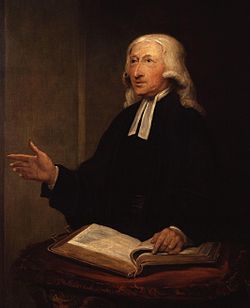 |
| John Wesley, by William Hamilton |
John Wesley was a famous preacher and prolific writer who often sought to make abstract doctrine or obscure Scripture relevant to the everyday lives of the people with whom he ministered. Although a number of sayings attributed to him today are disputed or can be shown to be false, many of them may still be considered true to his teachings. One of those that rings true because it is linked with the General Rules of the United Societies, is this "rule of life":
Do all the good you can,Wesley believed in making the best use of every moment and resource available to us: "Never be triflingly employed" was one of the maxims of his moral code, reflecting his desire to serve God faithfully in every endeavor. In case it's not clear what kind of "good" you're supposed to do, Wesley preached repeatedly on love as the central Christian virtue. In "The Character of a Methodist," as Steve Manskar explains, Wesley describes that
by all the means you can,
in all the ways you can,
in all the places you can,
at all the times you can,
to all the people you can,
as long as ever you can.
[t]he mark of a Methodist is his or her love for God. Their devotion to God is complete. Methodists center their lives upon God who became one of us in Jesus of Nazareth. His life and teachings provide the way Methodists live their love for God in all aspects of life. No part of life is untouched by their devotion to God and the things of God. This means that the Methodist’s love for God compels him or her to love those whom God loves. Their daily life is shaped by obedience to the teachings of Jesus.Manskar, who serves as the Director of Wesleyan Leadership for the General Board of Discipleship, continues,
Methodism is designed to equip people to receive the gift of faith by practicing the discipline of love given in the person and teaching of Jesus Christ. The discipline of love sets them free to become fully the human beings God created them to be, in the image of Christ. The aim of Jesus’ life and teaching is equipping his disciples to participate in his mission in the world.Love God, love those whom God loves (that is, everyone), do all the good you can. Sounds like a pretty good summation of the way of Jesus to me. And a compelling case for taking part in campaigns to end suffering, provide healing, and offer abundant life as we are doing through Imagine No Malaria.
I especially like Manskar's focus that the discipline of love is as much for our own benefit as it is for the benefit of those who receive our loving acts. By loving others, by giving of ourselves, our gifts, our time, our energy, we are set free to become fully who God has created us to be, set free to be transformed more into the image of Christ. Jesus' mission in the world is not just for the sake of those who have less, those who are suffering, but it is liberating and transformative for all who participate in it, both as givers and as receivers - and if we do it well, I think we experience both sides of that equation in the same action.
So have you done all the good you can today? Consider joining us in doing good in Africa as we seek to end malaria deaths and bring healing in Jesus' name. You might find yourself set free in the process.
P.S. You can read more about John Wesley at the Wesley Center Online, the Wikipedia article, or you might try Wesley and the People Called Methodists, by Richard P. Heitzenrater, for a fuller account.
Thursday, March 14, 2013
Looking for resources?

You can also check out the latest Malaria Fact Sheet and Imagine No Malaria Ministry Overview.
In the coming weeks, we will be posting even more resources for you to view and download, but in the meantime, please feel free to contact Rev. Kerry Greenhill, Field Coordinator, at 303-733-3736 (Tues - Thurs) or by email at kerry [at] rmcumc [dot] com with any questions.
 |
| Rev. Mike Dent, Senior Pastor of Trinity UMC, Denver, helps distribute bed nets in Angola in October 2012. |
Tuesday, March 5, 2013
"Whatever happened to Nothing But Nets?"
As I meet with United Methodists at District Conferences and other gatherings across the Rocky Mountain Conference, a few questions keep coming up, often from people who are very committed to missions and service through the church. One in particular that seems worth clarifying is, "Whatever happened to Nothing But Nets?"
 Nothing But Nets, of course, is a campaign of the United Nations Foundation in partnership with the National Basketball Association/NBA Cares, The United Methodist Church, and several others. Begun in 2006, it brought malaria back into the public eye in the U.S., where a concentrated public health campaign all but eradicated malaria more than 60 years ago. "Send a net. Save a life." became a rallying cry to educate the U.S. public about how easy and affordable it is to support widespread malaria prevention in Africa (for just $10, an insecticide-treated bed net can protect up to four members of a family from malaria-infected mosquito bites for several years). Nothing But Nets was very successful, raising about $7.5 million in the first three years.
Insecticide-treated mosquito nets are still the best way to prevent malaria; however, other measures like draining standing water where the insects breed, trimming foliage and proper sanitation, are also critical. And while "nothing but net" is a great phrase in basketball, when it comes to malaria, prevention is only one piece of the puzzle. In other words, you want nets plus medication, hospital infrastructure, community education, and mass communication efforts.
 And so, in 2008, building on the success of Nothing But Nets, and with the assistance of grant funding from the United Nations Foundation and (later) the Bill and Melinda Gates Foundation, the UMC created a new, comprehensive program to fight malaria: Imagine No Malaria. It both continues the important preventive work of net distribution and builds on it, adding treatment, education, and communication strategies to bring about a sustainable victory over malaria in this generation.
The new goal is to multiply the impact of Nothing But Nets tenfold: to raise $75 million in gifts and pledges by 2015. This audacious goal has the potential to save millions of lives - mostly women and children, who are the most vulnerable and make up the majority of deaths from the disease - and to make it possible for millions more who would have lived with and suffered from malaria to have a more abundant life in Jesus' name.
Confusion arises because while Imagine No Malaria is the new focus for United Methodist efforts to fight malaria, Nothing But Nets still exists and is still active, and for some churches, it is still a meaningful outlet for fundraising and malaria awareness efforts. Gifts made to Nothing But Nets through a local United Methodist Church count toward the broader goal of reducing deaths from malaria, but they are not counted toward conference fundraising goals for Imagine No Malaria.* The UN Foundation has helped the UMC clarify that through Imagine No Malaria we are engaged in a new, more comprehensive initiative as a denomination, rather than partnering with the non-profit Nothing But Nets to focus on distributing bed nets only for prevention.
Given these options, I invite you to prayerfully consider how God might be leading you and your congregation to respond to Jesus' teachings to heal the sick and to care for "the least of these." Perhaps, with God's help, you can do more than you realize.
And however you are raising money to save lives, please drop me a line at the Conference office to let me know how your church is taking part in the work to end death and suffering from malaria - email kerry[at]rmcumc.com or call 303-733-3736 x152. Blessings on your work to help others live life to the fullest!
*This post originally stated incorrectly that gifts to Nothing But Nets do count towards Imagine No Malaria fundraising goals. Updated 4/11/13.
Insecticide-treated mosquito nets are still the best way to prevent malaria; however, other measures like draining standing water where the insects breed, trimming foliage and proper sanitation, are also critical. And while "nothing but net" is a great phrase in basketball, when it comes to malaria, prevention is only one piece of the puzzle. In other words, you want nets plus medication, hospital infrastructure, community education, and mass communication efforts.
And so, in 2008, building on the success of Nothing But Nets, and with the assistance of grant funding from the United Nations Foundation and (later) the Bill and Melinda Gates Foundation, the UMC created a new, comprehensive program to fight malaria: Imagine No Malaria. It both continues the important preventive work of net distribution and builds on it, adding treatment, education, and communication strategies to bring about a sustainable victory over malaria in this generation. The new goal is to multiply the impact of Nothing But Nets tenfold: to raise $75 million in gifts and pledges by 2015. This audacious goal has the potential to save millions of lives - mostly women and children, who are the most vulnerable and make up the majority of deaths from the disease - and to make it possible for millions more who would have lived with and suffered from malaria to have a more abundant life in Jesus' name.
Confusion arises because while Imagine No Malaria is the new focus for United Methodist efforts to fight malaria, Nothing But Nets still exists and is still active, and for some churches, it is still a meaningful outlet for fundraising and malaria awareness efforts. Gifts made to Nothing But Nets through a local United Methodist Church count toward the broader goal of reducing deaths from malaria, but they are not counted toward conference fundraising goals for Imagine No Malaria.* The UN Foundation has helped the UMC clarify that through Imagine No Malaria we are engaged in a new, more comprehensive initiative as a denomination, rather than partnering with the non-profit Nothing But Nets to focus on distributing bed nets only for prevention.
|
| Children greet Bishop Elaine and other members of the UMC delegation to distribute nets in Bom Jesus, Angola, in 2012 |
And however you are raising money to save lives, please drop me a line at the Conference office to let me know how your church is taking part in the work to end death and suffering from malaria - email kerry[at]rmcumc.com or call 303-733-3736 x152. Blessings on your work to help others live life to the fullest!
*This post originally stated incorrectly that gifts to Nothing But Nets do count towards Imagine No Malaria fundraising goals. Updated 4/11/13.
Subscribe to:
Posts (Atom)